There’s something quietly special about picking up a small parcel of nasi jinggo from a roadside warung in Kuta late at night, unwrapping the banana leaf, and finding a perfectly composed little meal inside: a handful of warm rice, a spoonful of sambal, shredded chicken, some tempeh, a pinch of serundeng, all packed into something you can hold in one hand and eat standing up.
It costs next to nothing, it tastes genuinely good, and it connects you directly to a food culture that long predates any beach club or brunch cafe on the island.
If you’ve been exploring Kuta through the lens of SatuSatu, Bali’s curated travel platform for authentic island experiences, adding nasi jinggo to your eating list is exactly the kind of local discovery that makes a trip feel real.
What Is Nasi Jinggo?
Nasi jinggo, sometimes spelled nasi jenggo, is one of Bali’s most distinctive street foods. It consists of a small portion of white rice packed with several side dishes and sambal, all wrapped tightly in a banana leaf to keep everything warm and fragrant.
The banana leaf isn’t just packaging; it imparts a subtle green, grassy note to the food that shifts the flavor in a way that eating the same contents from a plate never quite replicates.
The typical components of a nasi jinggo include white rice, ayam suwir (shredded spiced chicken), serundeng (sautéed grated coconut with spices), sambal goreng tempe (tempeh fried with chili), and a chili sauce.
Variations exist across vendors and regions: some use yellow rice, some add thin egg noodles, others include half a boiled egg or a piece of pork (a uniquely Balinese touch that sets it apart from similar wrapped-rice dishes elsewhere in Indonesia). The beauty of the dish is exactly this variability within a consistent structure.
The History and Name Behind the Dish
Nasi jinggo’s story begins in Denpasar in the 1980s, when a Javanese husband-and-wife team started selling the dish on Jalan Gajah Mada, near the 24-hour Kumbasari Market.
The market’s round-the-clock activity created demand for affordable late-night food, and the banana leaf parcels were a practical solution: easy to prepare in bulk, easy to transport, and easy to eat anywhere.
The origin of the name “jinggo” carries a few competing theories, none fully confirmed. One connects it to the Chinese Hokkien phrase jeng go, meaning “one thousand five hundred,” which was once the price of a single parcel before the 1997 Asian financial crisis.
Another traces it to the 1966 Italian Western film Django, a title that circulated widely in Bali at the time. A third theory ties it to the Balinese slang term jagoan, referring to young motorcyclists who made nasi jinggo their late-night fuel of choice after rides around the island.
The uncertainty around the etymology is itself part of the dish’s cultural texture. From those roadside origins, nasi jinggo became a fixture not just as street food, but in Balinese ceremonial life.
It appears at Ngaben funeral rites, birthday gatherings, and community meetings, woven into the social and spiritual fabric of Balinese daily existence in a way that few other dishes manage.
What Makes Kuta a Good Place to Try It
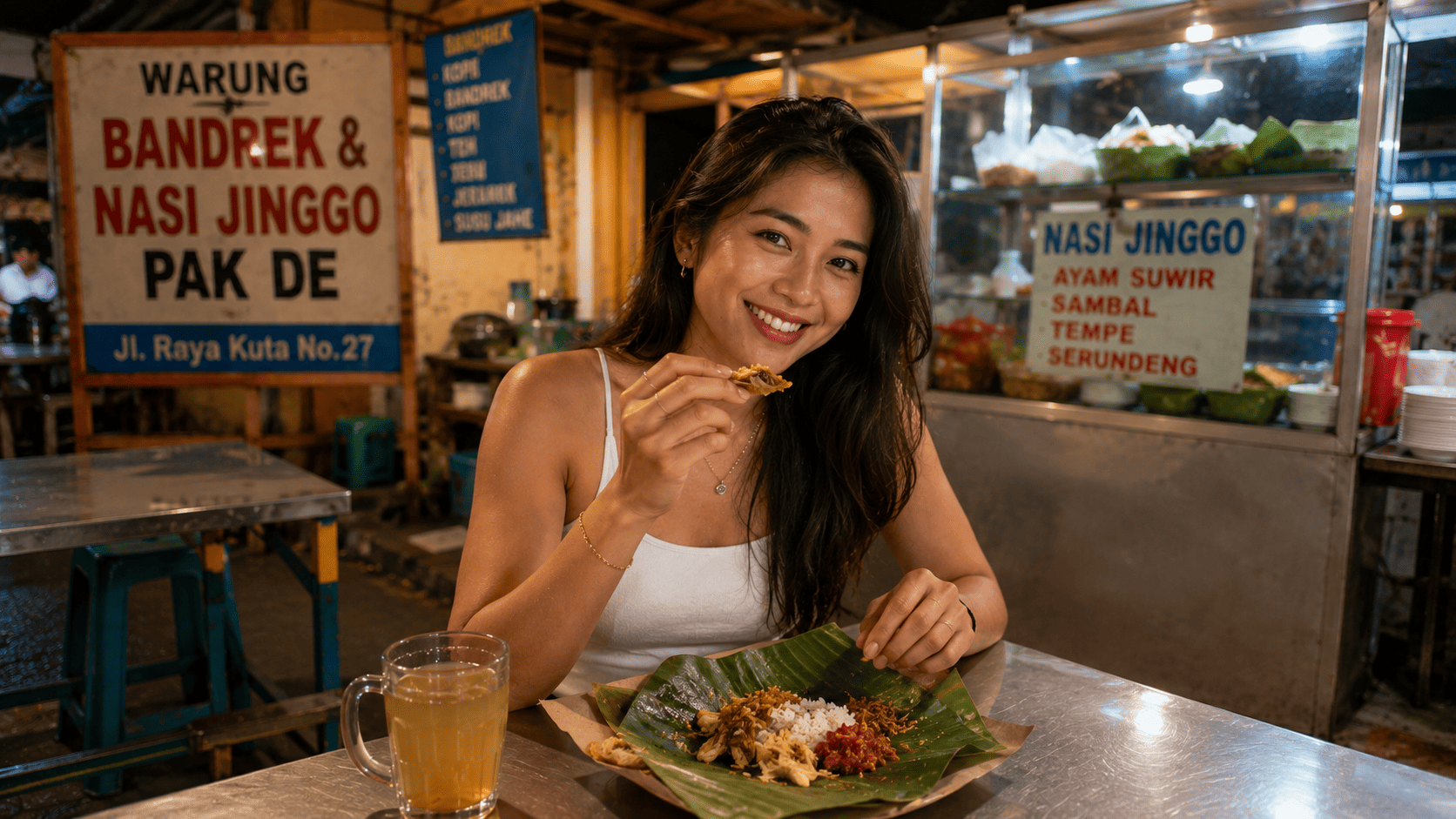
Kuta is one of the most accessible starting points for first-time nasi jinggo experiences precisely because the area’s mix of local warungs and heavy foot traffic means vendors are plentiful and the dish is available at almost any hour.
Unlike some authentic Balinese foods that require venturing into residential neighborhoods or arriving at specific morning market hours, nasi jinggo in Kuta can be found in the early morning, midday, and especially late into the evening.
Warung Bandrek & Nasi Jinggo “Pak De” on Jalan Raya Kuta No. 27 is one of the most frequently mentioned spots for nasi jinggo in the Kuta area. The warung is known for its classic preparation: rice, shredded chicken, sambal, and serundeng at prices that keep the dish accessible for both locals and budget-conscious travelers.
A single parcel here has been reported at around IDR 7,000, though prices may vary. The bandrek (a warm ginger and spice drink) served alongside is a noted pairing, particularly on cooler evenings.
For visitors, the experience works best when approached without expectation of a sit-down dining setup. Nasi jinggo is by nature a grab-and-hold meal. Some warungs have simple plastic chairs and low tables; others are essentially roadside counters. Either way, the food is the point.
How to Eat Nasi Jinggo Like a Local
The unwritten etiquette of nasi jinggo is straightforward. You approach the vendor, tell them how many parcels you want, and sometimes specify a protein preference if options are available. Some vendors offer additions like sate lilit (Balinese fish satay skewers), a half-boiled egg, or extra sambal on the side.
Asking what’s available that day is always a good move, particularly at warungs that rotate their side dish selection.
Eating it while the banana leaf is still warm gives the best experience. The heat activates the leaf’s aroma, and the sambal penetrates the rice in a way that a few minutes of cooling diminishes.
Most Balinese eat nasi jinggo as a morning meal or a late-night snack rather than a formal lunch or dinner, though there are no real rules. Some vendors near Kuta’s busier streets keep operating until midnight or later, making it a natural post-dinner supplement or a bridge between sunset drinks and sleep.
One practical note for visitors from non-sambal-eating backgrounds: most nasi jinggo carries a moderate to strong chili heat.
If you’re sensitive to spice, it’s worth asking the vendor for a mild version (sambal sedikit), which most warungs are happy to accommodate, though the dish does lose some of its character without the sambal’s heat.
The Wider Nasi Jinggo Scene Beyond Kuta
While Kuta is an easy entry point, the broader nasi jinggo scene across Bali rewards those willing to explore. Denpasar, where the dish originated, has some of the most established vendors with decades of daily practice behind them.
Jinggo Om Gundul on Jalan Imam Bonjol in Denpasar Barat is one of the more celebrated spots, offering a wide variety of protein options including chicken, shrimp, beef, and fish, alongside Balinese snacks and kakul satay.
The concept there leans into the angkringan style: multiple small options chosen a la carte, eaten communally.
Nasi Jinggo Marimar in Denpasar’s Peguyangan neighborhood is another institution, reportedly operating for over 30 years and producing up to 3,000 parcels a day during peak periods. The sambal at Marimar has its own following, described by regulars as deeply spiced and habit-forming.
For travelers building an itinerary around authentic Balinese food, adding a dedicated nasi jinggo excursion to Denpasar alongside a Kuta tasting is a genuinely worthwhile half-day project.
Explore Kuta Further with SatuSatu
Nasi jinggo is one of the most honest expressions of Balinese food culture, and SatuSatu makes it easy to build a full Bali experience around discoveries exactly like this one.
SatuSatu is a Bali travel platform that brings together transport, cultural experiences, and curated activities in one place, all bookable directly on SatuSatu.com with support for local payment methods including BCA, Mandiri, OVO, DANA, credit cards, and more.
Every great Bali food adventure begins with a smooth arrival, and SatuSatu’s Airport Transfer delivers exactly that: fixed pricing, same-day booking, no negotiating, straight from Ngurah Rai to wherever you’re starting your Kuta experience.
Once you’re ready to venture beyond Kuta toward Denpasar’s nasi jinggo warungs or other parts of the island, SatuSatu’s Exclusive Car Charter provides a dedicated local driver and full schedule flexibility to follow your appetite wherever it leads.
And for one of Bali’s most unforgettable cultural evenings, pair your street food discoveries with the Kecak Fire Dance at Uluwatu, Bali’s iconic sunset performance on the cliffs above the Indian Ocean.

And if you want to do more across Bali without the hassle of planning each activity separately, the SatuSatu Bali All-Access Pass is the smartest way to stretch your trip further.
Choose from a 1-day pass at $59.95 (IDR 999K), a 2-day pass at $104.95 (IDR 1.799M), or a 3-day pass at $144.95 (IDR 2.499M), and unlock access to 50+ top Bali experiences spanning destinations across the island, from the Kecak Fire Dance at Uluwatu to snorkeling in Padang Bai and wellness and spa experiences across Bali.
Every pass includes a free eSIM and a dedicated Bali concierge to handle all the planning for you, saving you up to 60% compared to booking individually, with 90-day validity from purchase for maximum flexibility.
FAQ about Nasi Jinggo Kuta
What is nasi jinggo Kuta?
Nasi Jinggo is a traditional Balinese street food commonly found around Kuta. It consists of banana leaf-wrapped rice with shredded chicken or other protein, serundeng, tempeh, and sambal, usually priced around IDR 5,000–10,000 per parcel.
Where is the best place to eat nasi jinggo in Kuta?
Warung Bandrek & Nasi Jinggo Pak De on Jalan Raya Kuta No. 27 is one of the most popular spots, known for classic nasi jinggo and traditional bandrek ginger drinks.
What time is nasi jinggo sold in Kuta?
Nasi jinggo is available throughout the day, but it’s especially popular as a late-night and early-morning food. Many roadside vendors stay open until after midnight.
Is nasi jinggo spicy?
Yes. Most versions include moderately spicy sambal. Visitors can ask for less sambal by saying “sambal sedikit.”
Is nasi jinggo vegetarian-friendly?
Some vendors offer tempeh-only or egg-based versions, though chicken is the default filling. Pork versions are also available at certain Balinese warungs.